

 Tom Shepstone
Shepstone Management Company, Inc.
The hard data on the health impacts of shale gas development is already available, contrary to the suppositions of Governor Cuomo and it shows shale gas is a very healthy deal.
Our good friend Uni Blake, over at Shale Health, has an excellent post noting the health benefits accruing from shale gas development. Here is some of what Uni notes:
The bottom line, increased utilization of natural gas continues to improve air quality in major cities. According to Mayor Bloomberg, NYC has decreased SO2 emissions by 69 percent and soot is down 23 percent (Huffington Post, September, 2013). Thanks in part to expanded natural gas usage.And, a study released by Clarkson University in 2011, shows that Rochester is also experiencing cleaner air since its conversation to natural gas – SO2 down by 53 percent and particulate matter down by 43 percent between 2002 and 2009. This is also in part to natural gas conversions (Democrat, February 2011).For those of without respiratory issues, this is all well and good but to 15 percent of the Rochester population with asthma, this is great news.
This prompted us to dig a little deeper and these are far from the only studies demonstrating the health benefits from conversions to natural gas from other fuels, conversions made ever more economically feasible by shale gas development here in the US, and especially in Pennsylvania.
Here are some more evidence of what shale gas is doing for public health:
2013 Connecticut Comprehensive Energy Strategy
 This thorough report, published in November, 2013, offers a politically correct message on a host of energy issues, carefully attuned to the Connecticut voter. It is, therefore, careful to attach caveats to its recommendations to convert more businesses, homes and state-owned facilities to natural gas heat and power, but acknowledges what cannot be denied (emphasis added):
The emergence of new extraction techniques (most notably horizontal drilling and hydraulic fracturing, or fracking) have made it economic to bring enormous amounts of new domestic natural gas supply to the marketplace from shale basins across the country (including in the mid-Atlantic states)…
This recent development presents Connecticut residents and business owners with a once-in-a-generation opportunity to switch to a cheaper, cleaner fuel source. Replacing fuel oil with natural gas offers the prospect of lower energy bills. Burning natural gas also decreases the level of harmful air pollution in comparison with fuel oil – and even more dramatically in comparison to coal…
Due to several factors, but most notably the dramatic shift from oil and coal generation in the region to lower-emitting natural gas generation, there has been a dramatic reduction in carbon dioxide emissions from electric generating units over the past few years. Between 2009 and 2011, regional emissions were 34% below the current regional carbon dioxide cap. These lower carbon dioxide emissions are great news for the environment and public health.
It will come as no surprise that many Connecticut voters would be just thrilled to ban fracking from the state as a symbolic act while they continue to receive these health benefits courtesy of Pennsylvanians and others, but that’s the Northeast NIMBY way so we’ll not lose sleep over it. They at least admit to the facts – shale gas development here has been for health there and they, unsurprisingly, want a lot more of it.
Public Health Benefits of Converting the Riverside Coal Plant to Natural Gas
This report was prepared in 2002, for the City of Minneapolis Health and Family Support agency. This, of course, was well before most of what we now refer to as the shale gas revolution, so it reflects none of the bias against fracking and the like we’ve come to expect from certain quarters. Moreover, it was in advance of the coal to gas conversion it studied, a then proposed project regarding that city’s Riverside Power Plant, which was fueled by coal. The conversion took place several years later and is described in this short video:
The reader will note emissions were substantially reduced as a result of the conversion even while expanding capacity. The pre-conversion study estimated the value of these reductions in community health terms in two tables, which are combined below:
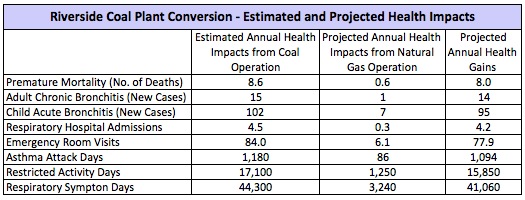
The video demonstrates the projected benefits were underestimated, as the table is based on a 93% reduction in emissions and the actual was 99%. Nonetheless, it highlights just how much of a positive difference in the health of urban residents can take place as a result of switching to natural gas for power generation. Today, that natural gas is, for many cities, mostly shale gas, New York being the primary example:
Dhaka Study Demonstrates Benefits of Conversion to CNG
The conversion possibilities don’t end with electricity generation, though. A 2011 study by Bangladesh University of the health benefits associated with conversion of vehicles to compressed natural gas (CNG) use in that nation’s capital city, Dhaka, indicates they are considerable. Here are some excerpts:
Dhaka, the capital of Bangladesh, has a poor air quality (one of the worst in the world, Gurjar et al. 2008), and a significant portion of the local air pollutants are generated from its motor vehicles. Local air pollution has recently been recognized as a major health hazard for the residents in Dhaka and various policy measures have been taken to reduce emissions…
The situation has been further deteriorating as a result of economic growth, with corresponding prosperity and increases in vehicle ownership, resulting in congested roads and higher vehicle emissions. A recent estimate concluded that air pollution in Dhaka alone can be related to about 15,000 premature deaths a year (IRIN 2009)…
Use of CNG for petroleum vehicles had dual advantages for Bangladesh. Firstly, CNG is an indigenous resource, thereby it has the potential to save foreign currency that would otherwise be used to import petroleum for the transport sector. Secondly, the particulate emissions from CNG vehicles are much lower than corresponding petrol or diesel vehicle, helping improve the air quality (Kremer 1999). Accordingly, the government made conscious attempts to increase the use of CNG in transportation…
[The] mortality rate would have been 11% and 16% higher from cardiovascular and respiratory diseases in Dhaka had the conversion not taken place…
An impact-pathway model [was] developed to relate the changes in emissions resulting from the policy to changes in ambient air quality and resulting number of avoided premature deaths. It is estimated that around 6,000 premature deaths were avoided in Dhaka in 2009 because of the switch from petroleum to CNG vehicles.

Bangladesh Flag
The Bangladesh gas reserves are conventional but the country wishes it had shale gas lobecause its considerable supply still falls short of rapidly increasing demand. That’s no wonder given the health benefits and someone will be supplying the nation with that gas via pipeline or LNG terminal. It will, no doubt, be a shale gas producer.
The Big Picture on Shale Gas and Health
We published a piece a little while back that goes further into the global benefits of shale gas to human health. All these studies, of course, show the health benefits for the shale gas consumer side, and there are a lot more consumers than producers. Notwithstanding this, there are a considerable number of studies also quantifying the health benefits to shale gas producer communities. Our favorite posts on this subject are two that Uni Blake and Sue Mickley authored on Energy In Depth (see here and here). They demonstrate health improved in the Barnett Shale region as a consequence of shale gas development and put things in perspective very nicely.
There is also an Australian study that looked at the health of petroleum industry workers over many years and found this:
The age-adjusted death rate in men is significantly less than in the general Australian male population. Death rates in all major disease categories – heart disease, cancer, respiratory disease, diseases of the digestive system, and external causes (accidents, violence etc) – are also significantly less than the corresponding rates for the male population…
The standardized death rate from cancer in females is no different from that of the Australian female population in general.
And, It doesn’t end there either, as there is a recent study of the Pennsylvania gas fields showing childhood cancer rates have been unaffected by shale gas development. There is also this, this and this. The reader, by now, already has the big picture. There is little to no evidence of negative health impacts on the production side of things and some evidence of positive impacts due to increased wealth. Meanwhile, there is much evidence of positive impacts on the consumption side. That pretty well sums it all up, despite all the speculation, junk science and trial lawyer prattle from the other side. Shale gas is a very healthy deal.



This piece is pure propaganda! It mentions This “Study ” and “Another Study” and “Also a Study” which is misleading and patently deceptive! Tom Shepstone is a Paid Industry Parrot. Look up the “List of the Harmed” and see if people in the Shale Fields are experiencing these “Health Benefits”! Imagine the “Benefits” of gradually introducing Toxic ,Polluted Water into our Streams, Aquifers, and Food Supply! Benefits all go to the Industry as Profit.
List of the harmed ??? That list is a joke. I looked at some of those cases on that list. How does someone get diabetes from frac’ing like one of the claims ?? And you need to take the Hallowhich’s off that list because it has been proven they suffered no harm.
If you want a good laugh watch this video of one of the ones on that list. I couldn’t even watch it all because her claims are so ridiculous.
So why are you not promoting solar energy to the landlords of New York City to heat their buildings. The politicians have spent billions on development and the Taxpayers need some return on our money. Oh, that’s right, that is a Capitalist idea.
Pingback: Marcellus & Utica Shale Story Links: Mon, Jan 6, 2014 | Marcellus Drilling News
Pingback: Does New York New Mayor DeBlasio Have A Fracking Brain?