


Jim Willis
Editor & Publisher, Marcellus Drilling News (MDN)
Our favorite government agency, the U.S. Energy Information Administration (EIA), published an article on Friday that appears to “take sides” in the Pennsylvania debate over whether or not to institute a severance tax. Which is a disappointment.
Until now the U.S. Energy Information Administration (EIA) has stayed above the fray in such issues. The EIA article from Friday offers a grossly misleading side-by-side comparison of where states get their primary source of revenue to feed their voracious appetites to transfer wealth from those who earn it to those who don’t and how much is contributed by oil & gas severance taxes.
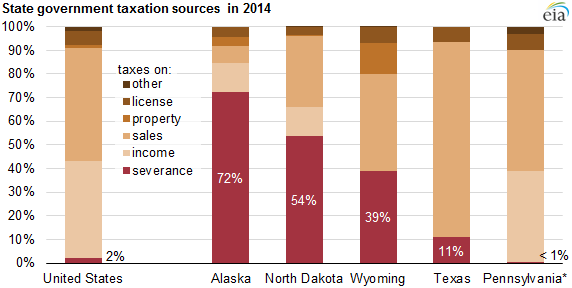
The EIA compares tax revenues from five major fossil fuel generating states; Alaska, North Dakota, Wyoming, Texas and Pennsylvania. The graphic they use is powerful (and misleading) and appears to support calls to increase a severance tax in Pennsylvania. We disagree, strongly with that position. Here is the EIA post from Friday, followed by MDN’s explanation of how it is grossly flawed.
Major fossil fuel-producing states rely heavily on severance taxes
Republished August 21, 2015, 4:00 p.m. to clarify text.
Several states that produce large amounts of fossil fuels rely heavily on severance tax revenue, taxes based on the volume and/or value of oil, natural gas, coal, and other natural resources. On average, severance taxes accounted for less than 2% of state tax collections in 2014, but in three states, Alaska, North Dakota, and Wyoming, severance taxes provided a much larger share of total state tax revenue in that year. Pennsylvania, on the other hand, is considering a severance tax, and currently derives less than 1% of its revenues from a well head fee.
Alaska. Alaska relies on revenues from oil and natural gas production for up to 90% of its budget, and consequently the state experiences fluctuations in tax receipts that reflect changing oil and natural gas prices. The Alaska Clear and Equitable Share Wellhead tax is calculated at 25% of operators’ net income (revenues after operating expenses and capital expenditures) before adjustments and credits. In the first quarter of 2015, the state lost $5 million in severance tax revenues as production companies had negative net income because of falling oil prices and the application of tax credits. Money from Alaska’s Permanent Fund as well as statutory and constitutional budget reserve funds helps the state reduce the effect of year-to-year fluctuations of severance receipts.
North Dakota. The second-largest oil producing state (after Texas) has seen its reliance on severance tax revenues grow along with the growth of tight oil production in the Bakken region. Between 2001 and 2014, North Dakota oil production increased from 87,000 barrels per day (b/d) to 1.1 million b/d, with severance tax receipts over the same period growing from $164.6 million to $3.3 billion. In 2001, severance taxes accounted for 14% of state tax revenues, growing to 54% in 2014. First-quarter 2015 severance tax receipts of $442 million are half of the state’s all-time high of $982 million in the third quarter of 2014. In response to low oil prices, in April 2015 the state passed legislation to revise its severance tax structure, making revenues more predictable. The legislation reduces the oil extraction tax to 5.0% from 6.5% beginning January 2016 and repeals existing statutes that trigger severance tax reductions when oil prices stay below a reference price of $55 per barrel for several months.
Wyoming. The nation’s foremost coal-producing state receives nearly 40% of state revenues from severance taxes. Since 2000, natural gas, rather than coal, has been the largest source of Wyoming severance taxes because of a significant increase in natural gas production. High crude oil prices and increases in production elevated crude oil to the second-largest source of severance tax receipts in fiscal year 2014. Wyoming state and local governments also derive revenue from property taxes, with coal, oil, and natural gas totaling more than 50% of state-assessed valuation.
Texas. The nation’s largest oil- and natural gas-producing state collected $931 million in severance tax revenues in the first quarter of 2015,more than Wyoming collects in an entire fiscal year. The first-quarter total is down 46% from the $1.7 billion collected in the third quarter of 2014. However, severance taxes cover only 11% of the state operating budget. Texas state and local governments also derive greater oil and natural gas revenues from state land leases and local property taxes. Like Alaska and Wyoming, Texas does not have an individual income tax.
Pennsylvania. Unlike the states discussed above, Pennsylvania, the country’s second-largest natural gas producer, derives revenue not from severance taxes but from an annual wellhead fee based on the number of wellheads drilled and the wholesale prices of natural gas. From 2011 to 2014 the revenues from the impact fees were relatively flat (from $202 million to $226 million) despite production growth in the Marcellus region. This result was because horizontal fracturing techniques yielded increasing natural gas per well and prices remained low. Pennsylvania’s legislature is considering severance tax legislation that would require producers to pay a severance tax based on the production value and volume of oil and natural gas. The proposed severance tax is estimated to generate up to $1 billion in tax receipts. This amount would still be less than 3% of the state’s total tax collections because of Pennsylvania’s reliance on other sources of tax revenues.
Principal contributors: Grant Nülle, Robert McManmon

MDN’s View:
Here is where the EIA comparison falls down. They don’t take into account that oil and gas drillers in PA face a corporate income tax in addition to a severance tax, something those other states don’t levy. For the PA bar in the graphic above, see the bottom-most beige section, just above the tiny <1%? Part of that is income from oil and gas drillers and should be added to the <1% to be truly reflective of how much money the industry is paying in a “severance” tax, if you want to compare apples to apples. The graph is totally misleading.
Even PA Democrats themselves, the more honest among them, acknowledge that Wolf’s severance tax would be closer to 17.3% rather than the 5% he claims, making it the highest in the country .
And consider this. The amount of revenue, and number of people living in a state, is wildly different state to state. For example, here is the total state budget for each of those five states:
AK – $9.5 billion
ND – $6.9 billion
WY – $9.3 billion
TX – $99.7 billion
PA – $29 billion
Here’s the population in each of those states:
AK – 736,732
ND – 739,482
WY – 584,153
TX – 26,956,958
PA – 12,787,209
Alaska seems to be the extreme case, getting a full 72% of its revenue from the oil and gas industry. But then, who else would they get it from? Oil and gas makes up most of Alaska’s economy. Frankly, we wonder how much more oil and gas activity would take place in Alaska if they lowered their severance tax? Case in point: North Dakota *passed Alaska* several years ago to become the #2 oil producing state in the country, second only to Texas. North Dakota’s severance tax rate is less than half of Alaska’s (see below).
Finally, let’s have a look at actual severance tax rates, the biggest thing missing in the EIA analysis. Below is a simplified summary, there are a number of conditions, loopholes, ands/ifs/buts when it comes to severance taxes. We’ve tried to boil it all down to a simple, average rate:
(Note: We assume today’s Henry Hub rate of $2.68 per thousand cubic feet, or Mcf, when calculating percentages below.)
AK – Oil – 25%; natural gas – 25%*
ND – Oil – 11.5%; natural gas – 3.7%
WY – Oil – 6%; natural gas – 6%
TX – Oil – 7.5%; natural gas – 4.6%
*minus operating costs/capital expenditures, so actually something less than 25%, very hard to pin down because it’s so complex
We have to estimate Pennsylvania’s equivalent. PA does not have a severance tax per se, but instead levies an “impact fee” of $240,000 per well over the life of a well. Our calculations assume that the average well will produce 10 Bcf total. We must also add an estimate for how much income tax drillers pay. Here is our best guess at how PA stacks up with their existing fees levied on Marcellus drillers:
PA – Oil – 3.5%; natural gas – 3.5% (some people peg it closer to 5%)
Now you have the full context for how to think about the debate currently raging in PA over a severance tax. Marcellus drillers are already taxed, perhaps not as much as other states, but at a healthy clip nonetheless. It may seem counter-intuitive, but there is one truism that has been proven over and over, especially during the Ronald Reagan administration (which we were proud to serve in). That truism is this: If you tax something more, you get less of it. And the converse is true. What happens is if you tax something less, more of that activity will happen, ultimately bringing in more tax revenue overall! Reagan proved it by slashing income taxes. After he did so, total tax revenue to the U.S. treasury INCREASED.
If PA institutes a higher tax on drilling, revenue to the state from the Marcellus industry will drop, the opposite of what Wolf and the Democrats desire. Or perhaps killing the Marcellus industry IS what they desire?
For a look at how anti-drilling so-called “reporters” bastardize the EIA data to smear Marcellus Shale drilling in PA, just read the following taxpayer-funded article from PBS’ StateImpact Pennyslvania: Feds show Pennsylvania gas revenues sharply lower than other leading producers
Even normally supportive media sources have been snookered by the EIA report. Read this from the Pittsburgh Business Times: Pennsylvania gets smaller share of tax revenue from oil and gas extraction than Texas, Alaska
For more great articles on the subject of natural gas development every single day, subscribe to Marcellus Drilling News using this convenient link.
