


Jim Willis
Editor & Publisher, Marcellus Drilling News (MDN)
Marcellus and Utica Shale gas production is, contrary to the doomsayers and pessimists, set to continue to boom in the coming years.
David Hughes of the so-called Post Carbon Institute made one of the stupidest remarks he’s ever made in 2014 when he said, “I think the Marcellus is getting pretty close to the peak in [total] production…I wouldn’t be surprised to see a peak in the Marcellus this year, maybe next year at the latest.” Dumb.
Marcellus (and Utica) production has done nothing but go up since that time. Oh, the last few months the EIA has reported that Marcellus production is declining–a little bit. But that’s because of a lack of new drilling due to low low prices, a situation that is, right now, turning around. You can expect Marcellus production to pick up again very soon.

The fact is, there is decades (perhaps centuries) of Marcellus/Utica Shale gas supplies waiting to be tapped—with no let-up in sight. Forbes contributor Jude Clemente, one of our favorite Forbes writers, goes on a riff to talk about the huge amount of gas available in the northeast, and its key role in U.S. production:
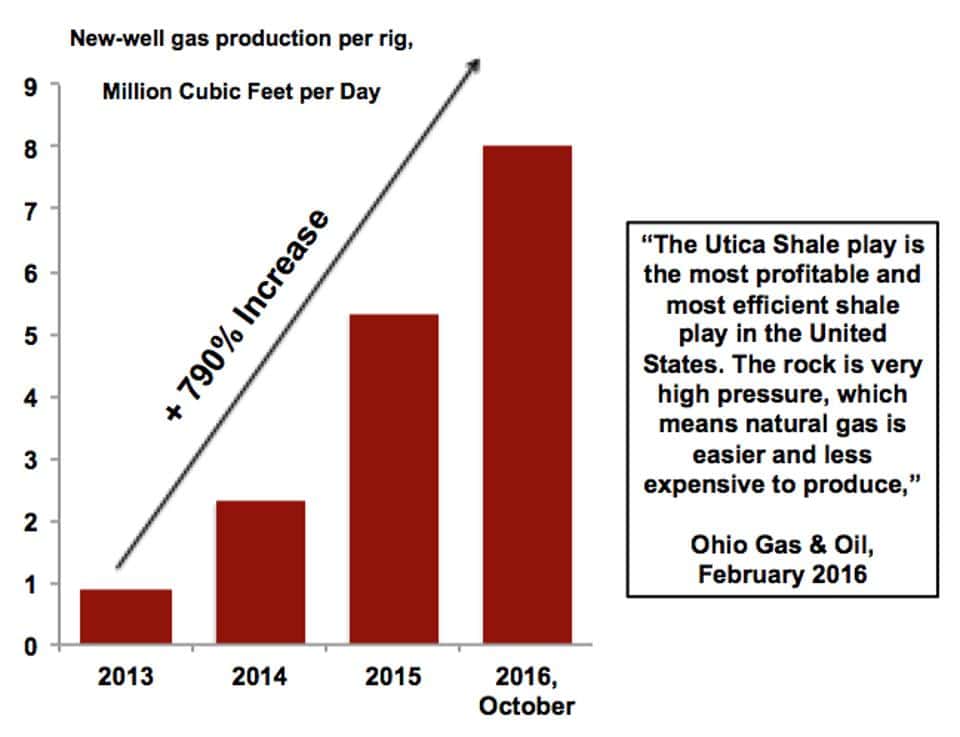
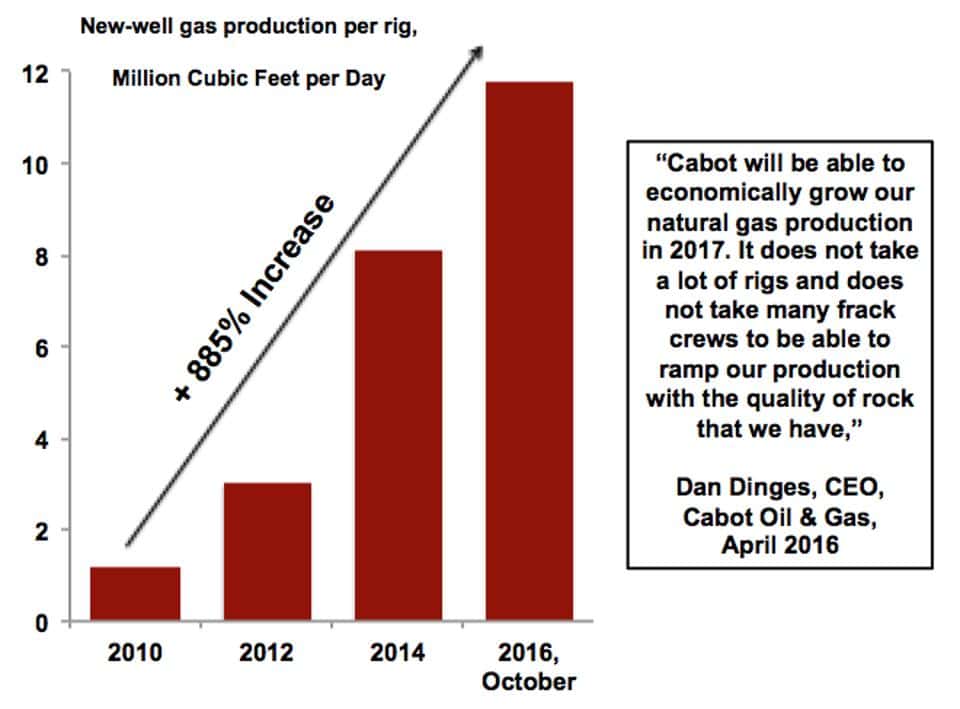
The Utica and Marcellus shale natural gas plays based respectively in Ohio and Pennsylvania have provided 85-90% of U.S. shale gas production growth since start of 2012. Their ongoing drilling efficiency is a key driver. In fact, increases in shale drilling efficiency have contributed to the breakdown of traditional methods that use rig counts to estimate oil and natural gas production. Frequently mentioned is how renewables continue to evolve, but so does the oil and gas industry. The shale business in particular continues to advance: rig mobility, multi-pad drilling, and other rapid evolutions mean more gas using less rigs and resources.
And there’s simply no sign of these giant plays in the Northeast slowing down, despite still lower prices in the region due to a lack of takeaway capacity. But, we could see pipeline additions of 18 Bcf/day over the next few years. And it will of course help that the three emerging baseload demand markets of power generation, industrial use, and export will continually put upward pressure on prices.
And we know that increasing demand induces increasing supply, perhaps the most important fact regularly omitted by the anti-shale industry. In short, there will be plenty of opportunities to produce lots more natural gas because, as a nation, we will be using lots more gas.
Sources: EIA: JTCRemember this from 2014:
“There may be small, incremental further gains…but I think the biggest gains have already been had…I think the Marcellus is getting pretty close to the peak in [total] production…I wouldn’t be surprised to see a peak in the Marcellus this year, maybe next year at the latest,” David Hughes, a fellow at the Post Carbon Institute, 2014 (here)
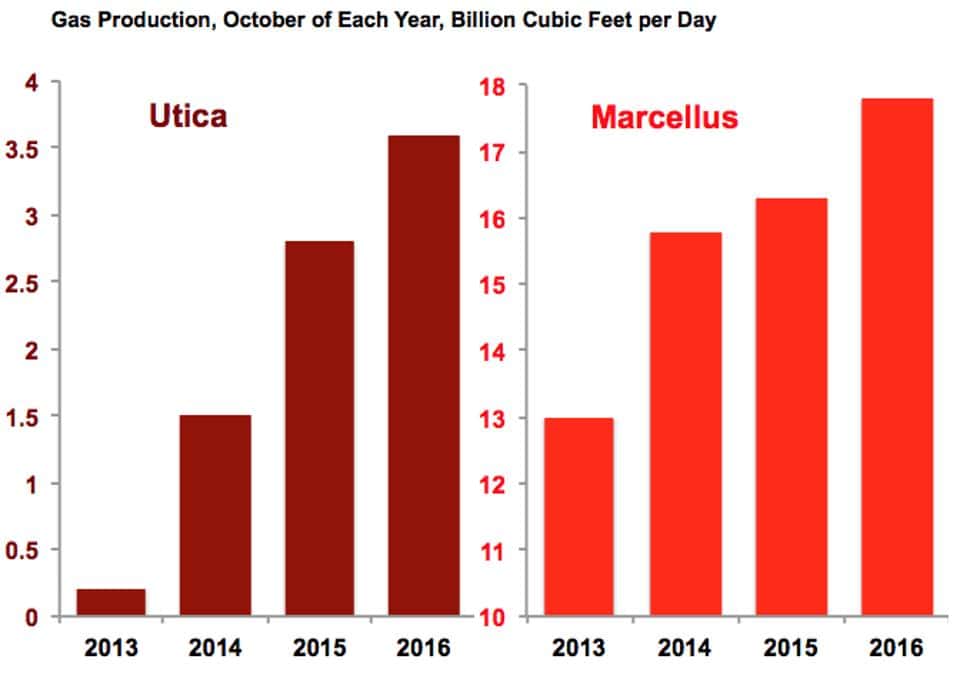
The reality, of course, has turned out to be much different. Marcellus gas production has jumped 15% since 2014. The Marcellus play this month will produce nearly 18 Bcf/day, which is more gas than any other nation in the world produces except Russia or the U.S. as a whole.
And the Utica and Marcellus both have so much more to offer. To illustrate, Ohio now has about 10 Tcf of proven gas, a 10-fold increase since 2009, and Pennsylvania has over 70 Tcf, a doubling since 2012 alone. Not even our very best experts at the U.S. Geological Survey can keep up. But, it’s a persistent theme, the more we explore and the more we develop, the more we realize how much we have.
The Utica and Marcellus are the basis of some 800 Tcf that can be produced at a break-even price of $3/MMBtu or less. These plays are the primary reason why EIA projects that total U.S. natural gas production will boom nearly 25% by 2025 alone to 96 Bcf/day – a colossal 85% surge since 2005 when Exxon CEO Lee Raymond infamously declared that our gas production had peaked. U.S. gas production has INCREASED EVERY SINGLE YEAR since 2006.
The Utica and Marcellus are why we are talking about a U.S. manufacturing renaissance built on a huge supply of affordable natural gas, are why we are talking about lowering CO2 emissions by using more natural gas, are why we are talking about a wind and solar buildout with gas as the integral backup, and why we are talking about exporting U.S. energy to a mostly energy-deprived world that could surely use it.
Given the importance of shale gas and fracking in the critical battleground voting states of Ohio and Pennsylvania, I was shocked and disappointed to not even hear the natural gas subject mentioned during the first presidential debate. Mr. Trump and Secretary Clinton must talk about whether they plan to advance or hinder the industry – and how. Ohioans and Pennsylvanians should know that fracking for oil and gas will be a crucial economic growth engine for them for decades.
Surging Utica/Marcellus Gas Production
Sources: EIA; JTC
The surge in natural gas production in the Northeast shows how quickly states can lower prices by producing more energy. California and New York, for instance, have refused to develop their shale and not coincidentally have the two highest electricity prices in the continental U.S. In contrast, gas producing giants Ohio and Pennsylvania have reversed a previous trend that had them with higher gas for power prices than the U.S. average.
As the U.S. continues to move toward using more gas, development of low cost shale is essential because it cuts costs for our businesses and gives them a competitive advantage globally. This is why the incessant talk on more and more regulations is so problematic from an energy security, environmental, and economic perspective, especially since methane emissions from fracked oil and natural gas wells have fallen 80%, even as production has surged (here). I’ve already shown: “Fracking And Natural Gas Have Cut Pennsylvania’s CO2 Emissions 30%.”
Editor’s Note: Jude Clemente is, indeed, one the best observers out there with respect to what’s happening with energy. I was also pleased to see Jim further draw out the comparison with the remarks of the ever wrong Post Carbon Institute—the peak oil people. There will always be a market for their hopelessly inept predictions because some folks ideologically opposed to oil and gas want them to be correct. Therefore, any hopes they’ll disappear into obscurity are sure to be dashed as they make one silly projection after another.

Another bad prediction
Still, is it too much to ask that responsible journalists and scientists check the facts before enabling their spin? Apparently, it is. The Post Carbon Institute’s Brian Schwartz continues to put out junk science studies every couple of months in a vain apparent attempt to make a self-fulfilling prophecy out of his own peak oil/gas predictions. All I can say is thank goodness for the Jude Clemente’s of the world who simply take time to uncover and discern the facts, which show the Marcellus and Utica shales are going to being powering this country for decades to come while cleaning up our air.
For more great articles on natural gas development every single day, subscribe to Marcellus Drilling News using this convenient link.

Please see link to related article Richard W. Goodwin 10/4/06
Goodwin, R.W.; “Doing More with Less – Resiliency of Shale Oil produced from Horizontal Drilling and Hydraulic Fracturing”; Oil Pro March 31, 2015
This article discusses
• USA technology improvements to horizontal drilling and hydraulic fracturing that enable producing more shale oil and liquid hydrocarbons while reducing number of operating wells
• Re-fracturing and micro-seismic technology are discussed to show their application reduces operating costs while increasing performance
• Break Even and Cash Negative operational drill costs for both WTI and Brent for USA E&P firms and OPEC
• Estimates of resurgence of Crude Oil Prices for 2016
http://oilpro.com/post/11740/doing-more-less-resiliency-shale-oil-produced-horizontal-drilling