

 Tom Shepstone
Natural Gas NOW
Texas makes a big point: that renewables and shale gas go together like a horse and carriage. Our energy choices aren’t confined to picking just one.
Our buddy Nick Grealy of No Hot Air has repeatedly made the case that renewables and natural gas are natural corollaries, not competitors and that fractivists ought to wake up and realize it. Texas wind energy development right along side shale gas development is quite often his case in point. It’s not quite that simple, of course. We see wind as inherently inefficient in many ways (particularly with respect to the amount of land required), unreliable and in need of constant subsidy. They see shale gas as a generator of CO2 and don’t like fossil fuels as a matter of principle. Leaving all that aside, though, Nick’s case is powerfully made by a recent Today In Energy post from the Energy Information Administration.
The article, entitled “Wind generates more than 10% of Texas electricity in 2014,” is really quite exciting because it simultaneously demonstrates the power of wind, the lack of any threat from shale gas and the need for shale gas. The article also benefits by some refreshing truth in labeling, as it talks mostly about wind energy generation, and not simply misleading capacity figures that we typically get from renewables promoters and naive media empathizers. The information, assembled by the EIA’s April Lee, is very revealing:
In 2014, more than 10% of the electricity used in the grid covering most of Texas came from wind generation, according to the grid’s operator, the Electric Reliability Council of Texas (ERCOT). Wind’s share of the ERCOT generation mix grew from 6.2% in 2009 to 10.6% in 2014 as total electricity generation increased over the same period by 11.3%. The growth in wind generation is a result of new wind plants coming online and grid expansionsthat have allowed more wind power to flow through the system to consumers.
Source: U.S. Energy Information Administration, based on the Electric Reliability Council of Texas (ERCOT)
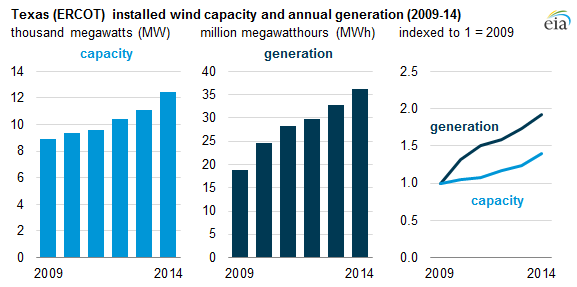
Wind generation in ERCOT nearly doubled from 18.8 million megawatthours (MWh) in 2009 to 36.1 million MWh in 2014. Wind capacity has also grown substantially over the past six years (and much more so in the years before that), but wind generation grew at a faster pace, partly because transmission constraints that previously prevented wind generators from operating at their maximum capability were gradually removed through a state-directed transmission expansion program. As these transmission constraints were removed, more generation from wind plants (largely concentrated in the northwestern part of the state) could reach the state’s population centers. The result has been a faster increase in wind generation than in wind capacity from 2009 to 2014…
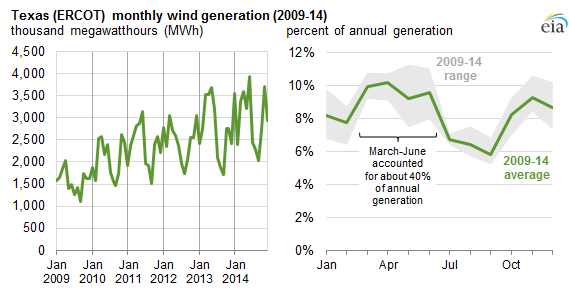
Wind’s contribution to ERCOT generation is not evenly distributed throughout the year. In Texas, peak wind season occurs during the spring—March to June—before significantly dropping off during the summer—July to September. Based on data for the past six years, the four months from March through June account for on average about 40% of annual wind generation in ERCOT. The graph on the right below shows a fairly consistent seasonal pattern from year to year, despite the difference in actual volumes of generation.
Source: U.S. Energy Information Administration, based on the Electric Reliability Council of Texas (ERCOT)
The good news for wind energy advocates is threefold. First, wind energy is growing rapidly as a source of electricity generation in Texas and it’s happening in the midst of a shale gas boom as well.
Secondly, the numbers are real. We’re talking generation and not the vague and illusory capacity data often thrown around to justify wind and make outrageous claims as to its viability. It’s viable enough without that exaggeration and provides a valuable source of supplemental energy that meshes well with natural gas and would probably do better without subsidies, another point Nick has made here.
Thirdly, the increases in wind energy electricity generation have come partly as a result of deregulation. Texas is letting wind compete and the result is good for everyone.
The good news, though, isn’t limited to wind advances. The word gas doesn’t appear in the Today In Energy story, but a close look at the right hand side of the chart immediately above indicates 40% of wind energy generation occurs in three months go the year; March to June. This illustrates the inherent nature of wind energy, which is erratic and comes during months that aren’t necessarily the times when energy is most needed for heat or air conditioning.
The contributions of wind energy to electricity generation vary from 6-10%, depending on the time of the year, meaning something else has to pick up 90-94% of the tab and that is, increasingly, shale gas. The following chart indicates what shale gas production from the Barnett, Eagle Ford, Haynesville and Permian plays has meant for Texas gas production as a whole.

Shale gas, in fact, is one the primary sources of the electricity generation needed when the wind isn’t blowing. It’s a stable source of energy that can be stored relatively easily and counted upon to deliver when needed. It’s the energy foundation for electricity generation, while wind is the supplemental source. Wind has its place, in other words, but it’s not in supplying the bulk of electricity or ensuring energy is available when most needed. That demands natural gas or coal and we know which one of those is preferable, don’t we?
This brings us to the heart of the matter; there’s plenty of room under the energy roof for both renewables and fossil fuels such as shale gas. There’s no need to choose one over the other, despite the fact most of us have strong feelings about which is the better choice. Reasonable minds can agree; there’s a need or at least an opportunity for both forms of energy.
Check out what else is new at NaturalGasNow today!

While you’re at it, follow us on Facebook, Twitter and Linked-In!

Why not build huge fans powered by NG to creat wind when there is none?Or maybe a backup generater that runs on decomposing bird and raptor carcusses? Or maybe spend all those wonderful billions from heavon susidies on research to develope cleaner ways to burn NG? -Great article Tom