

cold
 Paul Driessen
CFACT
….
….
[Editor’s Note: COP-26 is all about creating headlines and hysteria to move forward a corporatist agenda of green eggs and scam. Meanwhile, cold weather is the real killer.]
COP-26, the twenty-sixth massive climate control “conference of parties,” goes live in Glasgow, Scotland on Halloween. That’s certainly appropriate, since its primary purpose is to further terrify humanity to “take action” to prevent the “existential threat” of “manmade climate cataclysms.”
Thousands of politicians and climate activists will take private jets and limos to the lecture and hector halls – to demand that “commoners” be restricted to one Basic Economy flight every three years, meatless diets, public transportation, and keeping 640-square-foot homes at 65 F all winter and 85 F all summer.
Otherwise, they say, countless people will die as our planet “overheats” by up to 4.1 degrees C (7.2 F) by 2100. Real-world science and data provide no support for temperature spikes of this magnitude. But just in time for COP-26, Columbia University concocted a “new study” and “new metric” on the “mortality cost of carbon,” based on these scary computer-modeled temperature forecasts.
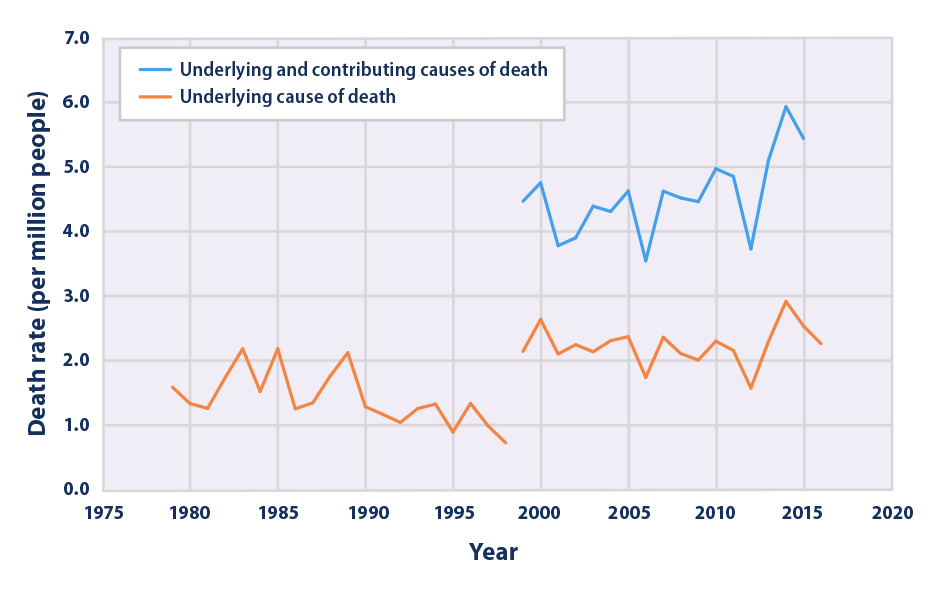
Source: CED, 2018. Note: This figure shows the annual rates for deaths classified as “cold-related” by medical professionals in the 50 states and the District of Columbia. The orange line shows deaths for which cold was listed as the main (underlying) cause. The blue line shows deaths for which cold was listed as either the underlying or contributing cause of death, based on a broader set of data that became available in 1999. Between 1998 and 1999, the World Health Organization revised the international codes used to classify causes of death. As a result, data from earlier than 1999 cannot easily be compared with data from 1999 and later.
Bloomberg News gave the death-by-global-warming fable prominent coverage. 83 million people (equivalent to the entire population of Germany) “could be killed” this century by rising planetary temperatures caused by fossil fuel use, it asserted. Nonsense.
Modern housing and energy systems enable people to adapt to and survive even the most extreme heat and cold – even in Antarctica, which just experienced the coldest average winter temperatures ever recorded: -61 C (-78 F).
Survival becomes far less likely, however, if climate treaties and energy policies prohibit efficient air conditioning and heating, ration them, subject them to recurrent blackouts, or make them harder to afford amid rising oil, natural gas, coal and electricity prices.
Yet, that is exactly what’s being advocated and implemented. Britain and various US cities and states want to ban natural gas heating and cooking – and replace them with expensive heat pumps and other electric appliances, powered by expensive, weather-dependent wind turbines and solar panels. Meanwhile, energy prices have been skyrocketing in response to Covid recovery and anti-fossil-fuel policies.
Climate theory has long held that most 21st-century warming will occur in northern latitudes during winter months. But now we’re now told a warming Arctic could also be causing colder winters, which could endanger far more people than rising temperatures or more frequent heat waves.
Actually, far more people die in cold weather than in hot weather or heat waves. In the United States and Canada, cold causes 45 times more deaths per year than heat: 113,000 from cold versus 2,500 from heat. Worldwide, where air conditioning is far less available, some 1,700,000 people die annually from cold versus 300,000 from heat – a ratio of almost 6:1.
Energy policies that favor wind and solar over fossil fuels beget “fuel poverty” that can make adequate heating impossible, causing numerous health problems and deaths. Poor, minority, elderly and fixed-income families are most severely and inequitably affected, it found.
Cold homes bring increased risks of respiratory and circulatory problems (including asthma, bronchitis, flu, cardiovascular disease and stroke) and exacerbate existing adverse health conditions. Cold household temperatures also increase depression, anxiety and other mental health problems. Already vulnerable groups – young children, older people and those with preexisting health issues – are especially susceptible to hypothermia, more illness and death.
Public Health England calculated that one-tenth of all “excess winter deaths” in England and Wales are directly attributable to fuel poverty, and 21.5% of excess winter deaths are attributable to the coldest 25% of homes. 30,000 to 40,000 people died each year in England and Wales since 1990 who would not have perished if their homes hadn’t been so cold, researchers estimated.
Adjusted for population, this is equivalent to 165,000 to 220,000 excess American winter deaths per year.
In 2017, Germany endured 172,000 localized blackouts; in 2019, 350,000 German families had their electricity cut off because they couldn’t pay their power bills.
Coal, oil, natural gas, electricity and home heating costs have risen significantly since those studies were prepared, likely increasing the excess winter death toll markedly. In fact, 2021 European gas prices skyrocketed nearly 600% over 2020 prices, and Rotterdam coal futures soared from $60/ton in October 2020 to $265/ton in September 2021. Energy prices are still rising, affecting jobs and living costs.
Global demand for gas and coal has surged as the world recovers from Covid. British gas production has plunged by 60 % since 2000; Britain and Europe have banned fracking; Putin is playing politicsover how much gas it will deliver to Europe; and President Biden has stymied leasing, drilling, fracking, pipelines, and oil and gas exports. Many coal and nuclear power plants have been shut down. Meanwhile, Europe’s heavily subsidized wind turbines generated far less electricity in 2021 due to unfavorable winds.
This perfect storm of misinformed policies could bring unprecedented excess deaths as winter sets in.
Schools, hospitals and clinics could also be much chillier – and deadlier. At 11¢ per kilowatt-hour (average US business rate), a 650,000-square-foot hospital would pay about $2.2 million annually for electricity. At 25¢ per kWh (UK), the annual cost jumps to $5 million; at 35¢ per kWh (Germany), to $7 million! Those soaring costs would likely result in employee layoffs, higher medical bills, reduced patient care, colder conditions, and more deaths.
Adding to these woes, Citigroup says EU natural gas prices could hit $100 per mcf (per thousand cubic feet or million Btu) if this winter is particularly cold and more Gulf of Mexico hurricanes disrupt production. News outlets report that energy companies supplying six million UK homes face collapse, and several elder care homes have warned that crippling energy bills could force closures, leaving many old and infirm people homeless.
Britain’s energy minister has said a “very difficult winter” lies ahead, as gas prices soar amid fear of blackouts and food shortages. Many households “will not be able to cope.”
US energy prices remain well below Europe’s, but threats to American families are also rising. The average monthly Henry Hub spot price for natural gas has shot from $1.63 in June 2020 to $5.16 in September 2021. That’s well below the highest-ever price ($13.42 in October 2005) but still ominous.
One-third of American households already had difficulty six years ago adequately heating and cooling their homes – and one-fifth of households had to reduce or forego food, medicine and other necessities to pay energy bills. Even before Covid, low-income, Black, Hispanic and Native American families were spending a greater portion of their incomes on energy than average US households.
Nearly half of US households that heat with natural gas will spend 22-50% more this winter than last year, depending on how cold it gets. Families that use electricity, propane or fuel oil to heat their homes will also pay significantly more. Energy-intensive factories may have to cut back hours and production, lay people off, and move operations overseas (where they will continue to burn fossil fuels and emit greenhouse gases).
Americans are also being impacted by gasoline prices that have risen more than a dollar a gallon for regular since the 2020 election and recently reached $5.00 per gallon in New York and $7.60 in one southern California town.
The overall effect of these anti-fossil-fuel policies on livelihoods, living standards, health and life spans will be profoundly negative. Countless people will perish, many of them cold and jobless in the dark.
Under Joe Biden, the United States is already on a trajectory to Europe’s real climate crisis: unaffordable, unreliable energy. That crisis better wake America up. Otherwise, self-righteous activists and governing classes will destroy middle class jobs, families – and lives.
Editor’s Note: For excellent additional perspective from a fellow who leans more left than right, read this post by Joel Kotkin.
Paul Driessen is senior policy analyst for the Committee For A Constructive Tomorrow (www.CFACT.org) and author of books and articles on energy, environment, health and human rights issues.
Follow Us on MeWe and Join Our
Natural Gas for the Future Group
 Also, be sure to give us a thumbs up below
and share on social media
if you liked this post!

For those who still posses the abilities to both observe and apply even minimal levels of critical thinking, the rapidly mounting evidence of the incoming Grand Solar Minimum should be the foundation for forward looking expectations.
An under emphasized aspect of Europe’s current energy drama is the fact that last winter was particularly long and cold, thus draining their natgas storage to abnormally low levels.
The early onset of cold in northern Asia is – likewise – prompting outsized amounts of natgas and coal consumption which is greatly exacerbating the global hydrocarbon availability situation.
These climate events will endure – with varying degrees of intensity and fluctuation – over the next 2 decades with the most prominent effects manifesting between 2028 and 2032.
The ‘Great Walkback’ (the downplaying of Globull Warming) is already in its nascent stage as the evidence of cold and wet is becoming too obvious to continue being ignored. (Nevertheless, increasingly frantic, deranged ‘explanations’ will gush forth targeting the most gullible and the ideological zealots who will deny Reality to the very end).
The more people who engage in self education and effective communication on this topic, the sooner that this collective madness will disappear from our lives.
Pingback: Global Warming 26.0, Is There Anything It Can't Do?