

 Tom Shepstone
Shepstone Management Company, Inc.
There’s a new renewables math out there being used to suggest renewables are a better alternative than natural gas, but the numbers don’t add up.
There is an energy con game taking place under the cover of political correctness. While renewables should clearly be a part of our future and are a natural complement to natural gas, the effort to sell them as an alternative to gas is a series of obfuscations that take us well off the path of sensible energy policies. The examples are everywhere, but gullible media types keep falling for the hype and fail to do the math. If they did, they see the new renewables math seldom works on any large scale unless it’s backed up by something like natural gas.
Are Renewables Really An Alternative to Natural Gas?
We recently came across a presentation by Oakland County, Michigan, Water Resources Commissioner Jim Nash, a committed fractivist and politician from the suburban area of Detroit. There is a lot that’s wrong with Nash’s presentation, including several false statements and exaggerations about things like water use, but what caught my eye was this slide:

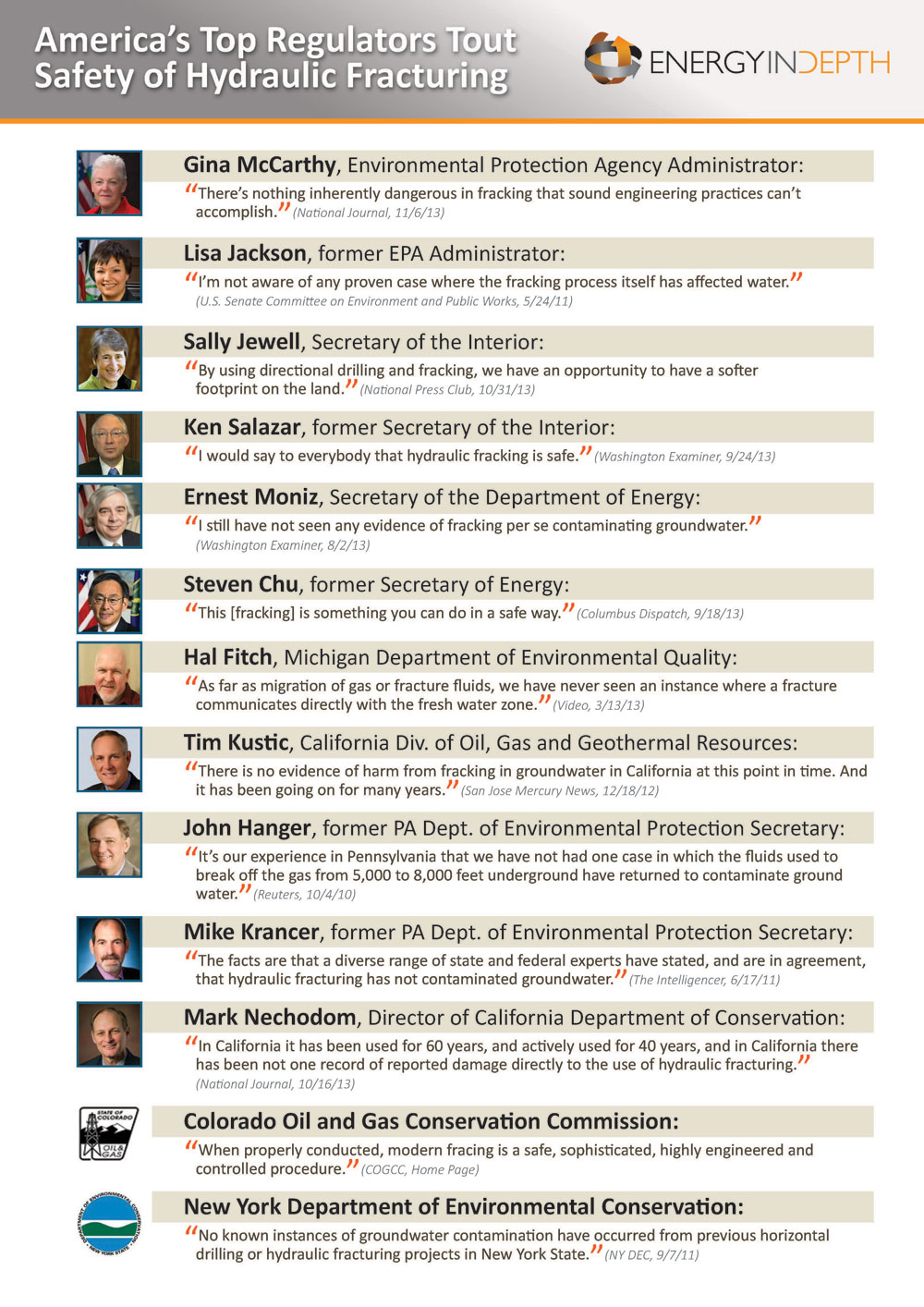
Nash thinks hydraulic fracturing is unsafe despite numerous state officials and virtually the entire Obama Administration saying otherwise, not to mention the lack of a single instance anywhere in the US where it has been found to pollute a water supply. Nonetheless, he wants “safer alternatives.” I’d love to know his definition of safety because there’s plenty of evidence the solar, wind and geothermal projects he promotes have issues connected with mining of rare earth minerals, land disturbance, bird killing and even methane migration. I happen to think those risks are minimal in the big picture. They shouldn’t stop us from developing renewables. Nevertheless, I wish Nash would be intellectually honest and admit the same regarding natural gas.
I also wish he’d stop exaggerating the contributions of renewables so we could move ahead honestly in developing all our energy resources, including those sources. When he cites all those megawatts of wind and solar installed he’s talking about their theoretical capacity, which is never realized, not their actual generation of electricity, which is typically somewhere between 20% to 40% of that capacity.
The real contributions of renewables, measured by energy generated, have, to date, been very modest and have come at great costs in subsidies from taxpayers. This means we are far from the point where we can afford to use them on a broad scale. We are currently borrowing from our children, our grandchildren and our great-grandchildren to finance energy sources that soothe our consciences but are yet impractical in the real world.
The New Renewables Math Applied
A good example of this is the Farmington Hills City Hall (pictured below), which Nash holds up as an illustration of why renewables are feasible as an alternative to natural gas. Farmington Hills is the second-largest city in Oakland County, with a population of slightly less than 81,000 people and a median household income of $67,526 for 2012, roughly a third higher than than the national average. More than half its labor force is employed in management, business, science and arts occupations. Some 91% of all Oakland County residents heat their homes with natural gas, but the city has been feted by Nash and others for building a new city hall that supposedly reduced their gas bill from $30,000 to zero.
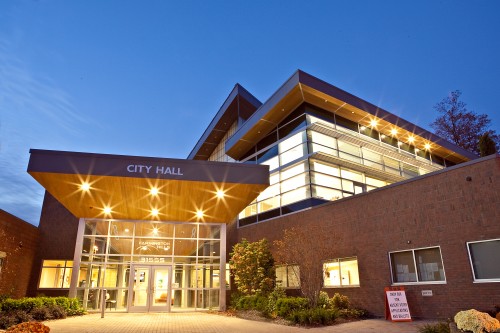
Look and sounds great, right? Well, maybe as a demonstration of what’s possible, but certainly not on practical grounds. Farmington Hills City Hall doesn’t make much sense as an energy policy. It effectively involves grabbing money from less affluent parts of the US, under a Department of Energy Block Grant program to make city residents feel good about themselves. That funding was apparently modest (about $250,000) and the project is far from the worst case, but it’s the sort of thing that happens with most renewable projects, where money flows to people who don’t need it to pursue trendy projects. Here’s another case.
Use of other people’s money for funding isn’t the main issue in Farmington Hills case, though. The city paid for the lion’s share of the $8 million project themselves and got a 50,000 square feet city hall out of it. City officials have said this means they got a Leadership in Energy and Environmental Design (LEED) certified building for $160 square feet, which is relatively low cost. However, it wasn’t a new building. There was an existing building of 34,000 square feet which was partially demolished to add the new space, which means the city paid $500 per square feet to add the space, notwithstanding the fact the money also want to a partial demolition of and improvements to the old building. The $160 figure spreads the cost over existing as well as new space.
Does Renewables Math Add Up for Farmington Hills?
Was this a good deal? Well, you be the judge.
Builders typically use services such as RS Means to estimate costs. According to this source, the median cost of building a new 2-3 story town hall of 16,000 square feet in that part of Michigan was, in late 2012, an estimated $2,989,500 or $187 per square foot. This means the remaining costs (roughly $5 million) represents the potential incremental cost of the renewable energy aspects of the renovated/new building as well as other renovations. This is more than 60% of the project cost and equal to $100 per square foot spread across the total 50,000 square feet.
What did the city get in return? Well, when it was proposed in 2009, it was projected to save $9 million in energy and operational costs, although, tellingly, no period for these savings was specified. Was it 10 years, 20 years or 50 years? Such vague justifications are often behind renewable projects. A year later things got a bit more specific when another news report stated the project, then nearing completion, “would save more than $1 million in energy purchases during the next 20 years.” This report also suggested the payback on the energy systems “could be anywhere from four to six, possibly eight (years).” City officials cautioned, however, the payback period on the entire City Hall project was difficult to assess, but … the building should “pay for itself over 20 years through energy and operational savings.”
I’m not sure what math the city officials are using, but investing $5 million now to get back $1 million over 20 years isn’t a good deal under any scenario. One might suppose there other savings attributable to a new building from an operational efficiency perspective (e.g., less maintenance costs) and but are we to believe they come anywhere close to the energy costs, let alone the $8 million difference in estimated savings?
Most likely, they do not, but let’s work backwards a minute. A cash flow of $1 million in savings over 20 years, net present valued at a discount rate of 5% is worth $623,000 today. That’s roughly how much money Farmington Hills could justify spending to get those projected $1 million of savings over the next 20 years. Everything else better have another explanation. Perhaps it does, but somehow I doubt it, as the city’s expenditures on building maintenance increased from $16,883 in 2009/10 (page 150) when its city hall was being renovated to $58,803 in 2011/12 when it was finished (page 158) due to this:
“Increase in 2011/12 estimated budget due to premature equipment failure. 2012/13 budget contains newly bid preventative maintenance items for the new City Hall which are more labor intensive.”
Hmm… What should we conclude from this? The city says it has achieved a 30% reduction in energy use and 70% drop in energy costs (79% per square foot) by comparing different years, but it also experienced a 248% increase in building maintenance costs as soon as the new building came on line. Moreover, the cost of utilities (which presumably includes both electric and gas) declined by only $13,317 or 20% between 2009/10 and 2011/12.
That’s a far cry from the 70% and it’s dwarfed by the $41,920 in increased maintenance costs. If there were any net savings whatsoever it’s not clear where they might be. If they exist at all, they are a lot less than the $50,000 per year in energy savings it would take to get $1 million in 20 years and they come nowhere close to justifying the additional millions in additional capital costs involved. There’s no payoff unless one uses the renewables math of only counting one side of the equation.
This brings us back to Mr. Nash and his assertions. Like so much else in his presentation, this is all about style, political correctness, self-esteem and ideology. It has almost nothing to with energy savings, environmental protection or economics. Unlike renewables themselves, which do have a valuable role as part of a bigger energy solution, the new renewables math simply doesn’t work. It produces negative numbers whenever advocates try to pile on with it. The answer is combine renewables with natural gas, so the math works, but don’t expect guys like Nash to stop spinning them as the alternative anytime soon. Their math is pretty fuzzy.



Once again tom you confront the “anti’s” shallow reasoning with the light of truth. To hear an anti gas nimby whine about the nimby effect in electric transmission is extremely amusing… Irony anyone? Having been born in the mechanical contracting trades, in my mind while I was reading your article, I asked the question “what about the increased maintenance?” which you addressed later in your article. Also “what about electricity costs?” which you addressed also.
If these fools were for real, they would help fix the fugitive methane coming from other sources like agriculture. Knowing something about sanitation and plumbing, I assert that most fugitive methane can be fixed. The fossil energy industry provides an apropos example…
Of course your economic analyses highlight the wishful and foolish thinking. (I’m not slamming hydro-thermal, as I may put one in my new house.) The economics are very critical of any real savings demonstrated! I could rant on, but you say it so well Tom… Kudos. Keep up the good work Tom…
Tom: As usual, great article! What always seems to get lost in the renewable argument is the issue of heat. I’ve done the calculation on substituting my gas furnace with solar panels and the numbers are mind – numbing. I would have to add another 116 panels to my present array of 22 panels https://www.facebook.com/frank.chernega.7 There is a huge catch though: when the sun goes down and the array is snow covered or the cloud cover attenuates my array output by 80%, what then do I do for heat? This heat issue should be incessantly referred to by our side in this debate as it is the Achilles heel of renewables.
Pingback: The New Renewables Math Doesnt Work, Even When Renewables Do « ShaleMarkets.com – Oil and Gas (O&G) Shale Supply Chain