

 Kelsey Mulac
External Affairs Intern, Cabot Oil & Gas
No clearer example of a well-crafted tax on the oil and gas industry is to be found than Pennsylvania’s impact fee, which directs funds to community needs rather than bloated state budgets and public employee unions.
The current Pennsylvania Impact Fee on the oil and gas industry is very beneficial to the Commonwealth and to the communities involved in the extraction of natural gas. The money taken from the Impact Fee is dispersed to every county in Pennsylvania, with large amounts going to communities where the most natural gas drilling occurs.
The 2014 production data – and subsequently the Impact Fee distribution for each county/municipality – have been released and the numbers remain beneficial for all of Pennsylvania. In 2014, Allegheny and Fayette Counties received over $1 million, Butler County received over $2 million, Lycoming County received over $4 million, and Susquehanna County received over $6 million in Impact Fee funds. These funds are being used for emergency preparedness and public safety as well as public infrastructure construction like roads and parks which are all vital to each community.
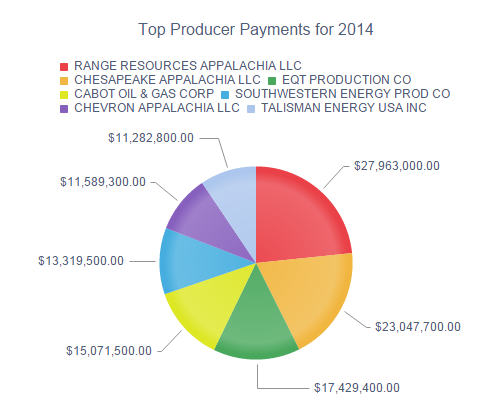 Marcellus Legacy Fund, which was established to fund environmental, highway, water and sewer projects, rehabilitation of green ways and other projects throughout the Commonwealth.
For our 2014 activity, Cabot alone paid more than $15 million.
How Does it Help?
In March, the Pennsylvania State Senate Environmental Resources and Energy Committee, and the Senate Local Government Committee, held a joint public hearing to discuss Impact Fee dollars from the oil and gas industry in the Commonwealth where local officials spoke about the positive effects the impact fees have had on their communities. Susquehanna County Commissioner, Alan M. Hall voiced his opinion by saying:
“Municipalities have used funds to improve bridges, sewer systems, roads, parks and equipment, to name a few… Susquehanna County is one of those few counties in the state where we have zero debt and our pensions fund is 100 percent funded. The county in also going through the growth of infrastructure in the communities, the distribution system of natural gas has begun in our communities giving homeowners and business owner’s energy savings. The county courthouse and office building is being converted to natural gas to provide heat. The court house was originally heated with 110 year old coal boiler and an oil fired boiler the size of a medium size package truck… these changes are providing an energy efficient, clean and healthy environment to the employees and tax payers. This is all possible through Act 13 funding.”
With the help of this Impact Fee, Susquehanna County supervisors are able to also buy new equipment and fix its roads. Lenox Township supervisor, located in Susquehanna County, Fred Benson, showed a WNEP16 news reporter some of the townships newest vehicles bought with the awarded Impact Fee money shown in the video below. He went on to talk about the importance of the Impact Fee hoping that it will stay in Pennsylvania forever:
“I hope it stays right here. Don’t take it away; as long as thelegislatures and the senate keep it here we’ll be alright.”
There is no question; the Impact Fee has been extremely beneficial for local spending and community services, which positively affects the lives of regular people all over the Commonwealth.
Original version of this post appeared on Well Said Cabot. See, too, our Severance Tax site on Tumblr.

I don’t understand why this isn’t publicized more. The politicos keep stating “it’s time they paid their fare share” and lay-folk think that O&G is just getting a free pass. You can see it in the comment sections of local Pgh papers under O&G articles.
Gov Tom wants to send it through Harrisburg to pay for schools among other things? Yeah, I bet there will be plenty left for local infrastructure and the like that is truly impacted.
Meanwhile, school taxes are all going up all around here. They told me once, a while ago, that the new casinos would pay for education. Shame on me.
Pingback: Tom Wolf's Severance Tax Political DisasterNatural Gas Now