

 Johnny Williams
Freelance Journalist
Pipelines are convenient, safe and economical to deliver energy. Along with the pipelines come opportunities. The PennEast Pipeline is such an opportunity.
It was probably at least five years ago, but it seems like just yesterday I was discussing with various people the eventual rise of pipelines as the soon-to-be primary activity of the natural gas industry. Drilling rigs are certainly still around; in fact I just saw one on March 15 near Meshoppen.
Rig sightings will likely never be as prevalent as they once were, and if and when a severance tax is passed they might even become somewhat of a rarity, but that’s a story for another day.
In any case, the “age of the pipelines” is upon us, and with it comes new opportunities for landowners, businesses, job-seekers, homeowners and Americans, in general. A great example of this is the proposed PennEast pipeline, which will be constructed from a partnership of AGL Resources, NJR Pipeline Company, PSEG Power, South Jersey Industries, Spectra Energy Partners and UGI Energy Services.

The PennEast pipeline is a proposed 114 mile long pipeline, made of primarily 36 inch diameter pipe, that will stretch from Dallas in Luzerne County to Mercer County, New Jersey. When it is completed, it will provide Marcellus Shale gas throughout its length from eastern Pennsylvania to New Jersey; up to one billion cubic feet per day, or enough for 4.7 million homes.
The relief that the pipeline will provide to these markets looks to be tremendous. According to a UGI press release issued in Aug. of 2014 that you can view here, “this past winter (of 2013-2014), natural gas prices in New Jersey traded as high as $100 per dekatherm. Natural gas in the area that PennEast will access traded in the range of $3 to $4 per dekatherm. The proposed pipeline will help reduce this price volatility to the benefit of New Jersey’s nearly 3 million natural gas consumers.”
That is a pretty large difference and Marcellus Shale gas transported by the PennEast pipeline should bring significant savings and stability to these markets, especially after sustaining one of the most brutal winters in recent memory.
By the way, New Jersey isn’t unfamiliar with the Marcellus Shale by any means. The day before this writing, I was in New Jersey visiting relatives and I literally drove right by South Jersey Industries’ beautiful facility. Billboards illustrating the savings of switching to natural gas are not uncommon. South Jersey Gas even has several CNG stations in that area. Being from southern New Jersey, I can say it’s quite a feeling to actually see the gas being extracted from my current backyard going towards helping people in my former backyard.
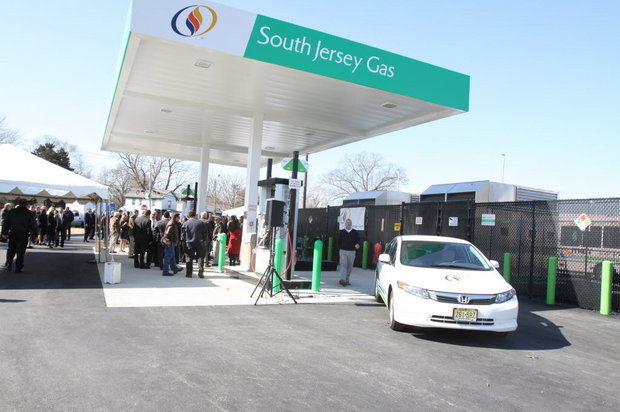
A South Jersey Gas compressed natural gas station in Glassboro, N.J.
New Jersey wants this gas, along with the jobs that come with it. Teamsters Local Union No. 469, based in Haslet, N.J., wrote a formal letter to the Federal Energy Regulatory Commission (FERC) in support of pipeline, citing local natural gas and local jobs as key reasons to get behind the project.
Another union getting behind the project is the Steamfitters Local Union No. 420, who also wrote a formal letter to FERC supporting PennEast. Interestingly enough, Steamfitters is based in Philadelphia, a city which, not so long ago, sought a natural gas drilling ban.
However, this is only what will be the end result of this $1 billion project. As much as the delivery of cheaper, cleaner natural gas will help in the costs of these eventual customers for years to come, the construction of the PennEast pipeline will also bring a significant boost to local economies.
The Economic Impact Report of the PennEast project delves deep into how these economies will be affected by the construction, and it’s definitely worth a read, but I’ll go into a few of the interesting numbers that his report presents.
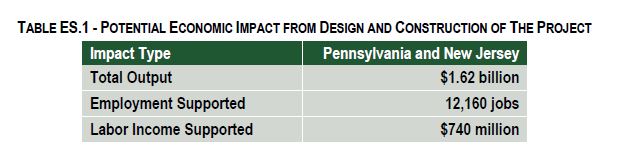
For example, the report estimates that the design and construction of the pipeline will generate $1.62 billion in one-time total economic impact. It will support 12,160 jobs and pay wages of approximately $740 million. Doing some quick math, that’s nearly $61,000 per job. Granted, the report admits that not all of these jobs will be filled by locals; there’s simply not enough qualified local people to fill all of those jobs. However, at bare minimum, the out-of-town workers still need to eat and sleep, which is great news for local hotels, campgrounds, restaurants and grocery stores.
Even after construction, there will still be economic impacts in the day-to-day operations of the line, besides the cost savings to customers. According to the report, long term jobs will reach 98 and $8.3 million in wages, or nearly $85,000 per job. And when construction is completed, while those businesses mentioned above may lose some of the business gained during construction, they will likely still benefit as the pipeline will bring increased savings and stability to their natural gas bill.
However, you could ignore all of that. Set aside the increased income for businesses, the jobs that would be gained, the money customers will save, and the increased use of a clean, American energy source, and there is still a case to be made for the positive impacts of the PennEast pipeline.
As a part of the project, PennEast has launched the Community Connector Grant Program, which focuses on providing funding for non-profit organizations promoting safety, the environment, education and energy workforce development, including first responders and other emergency services, habitat preservation and environmental and energy education.
Construction of the PennEast line, assuming the planning stages go well, is slated to begin in the Spring of 2017. Until then, the project is undergoing meetings with municipalities and affected landowners to plan the best route for the line and address concerns. Support for the pipeline is encouraged, and anyone can take action to help ensure that local natural gas is able to be put to use for our fellow American neighbors.
Check out what else is new at NaturalGasNow today!

While you’re at it, follow us on Facebook, Twitter and Linked-In!

Pingback: PennEast Pipeline: This is for You, Urban AmericaNatural Gas Now