


Jim Willis
Editor & Publisher, Marcellus Drilling News (MDN)
Natural gas reserves keep increasing (whatever happened to peak oil?) on the Marcellus Shale is the basis the awesome growth – this is our energy future!
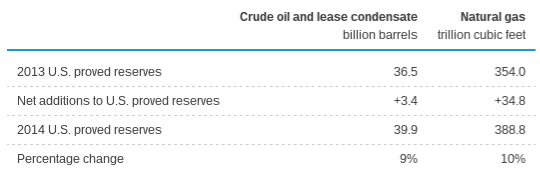
Our favorite government agency, the U.S. Energy Information Administration (EIA), yesterday released their annual report of proved oil and natural gas reserves in the United States for 2014. The report, titled U.S. Crude Oil and Natural Gas Proved Reserves, 2014 shows proved reserves for natural gas rose by 34.8 trillion cubic feet (Tcf), or 10%, to a record high of 388.8 Tcf in 2014.
Oil reserves rose 3.4 billion barrels, or 9%, to 39.9 billion barrels. That’s the highest oil reserves have been since 1972! So much for “peak oil,” I guess!
This is the second year in a row for a new natural gas proved reserves record high, and the sixth year in a row for oil proved reserves (see last year’s report, EIA: Proved Reserves for Natgas Up 10% Last Year, Marcellus Leads).
As a quick reminder, proved reserves are, according to the EIA, “those volumes of oil and natural gas that geological and engineering data demonstrate with reasonable certainty to be recoverable in future years from known reservoirs under existing economic and operating conditions.” That is, proved reserves are what’s in the ground now, can be gotten out, and we can prove it. This is a great report, full of excellent data and interesting charts and graphs, like this one, for instance:
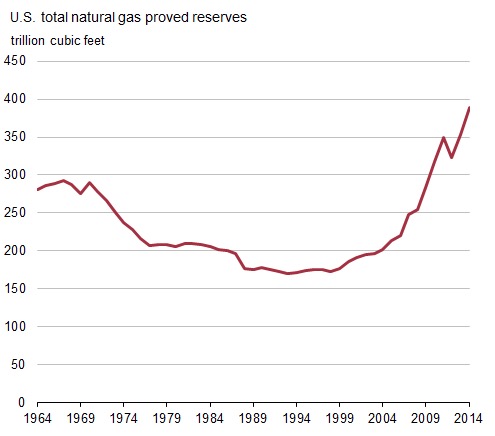
and, this one:
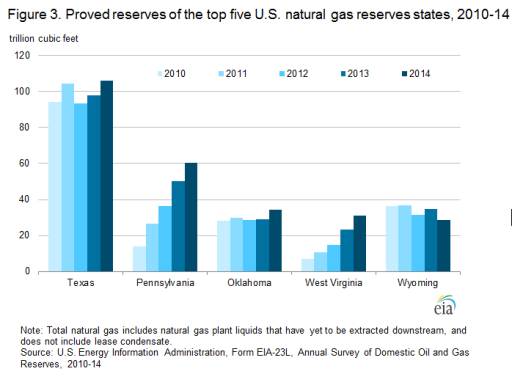
Notice that the Marcellus Shale (once again) contributed the most to the increase in the proved reserves numbers.
- Natural gas proved reserves rose 10% in 2014, setting a new U. S. record of 388.8 trillion cubic feet
- Oil proved reserves rose 9% in 2014, exceeding a U.S. total of 39 billion barrels for the first time since 1972
- Sustained lower prices for crude oil and natural gas in 2015 have curtailed oil and natural gas drilling and have reduced operating economics; this is anticipated to reduce end-of-year 2015 oil and natural gas reserves
U.S. crude oil proved reserves increased in 2014 for the sixth year in a row with a net addition of 3.4 billion barrels of proved oil reserves (a 9% increase), according to U.S. Crude Oil and Natural Gas Proved Reserves, 2014, released today by the U.S. Energy Information Administration (EIA). U.S. natural gas proved reserves increased 10% in 2014, raising the U.S. total to a record 388.8 trillion cubic feet (Tcf).
At the state level, Texas had the largest increase in proved reserves, 2,054 million barrels (60% of the nation’s total net increase) in 2014. Most of these new oil reserves were added in the Texas portion of the Permian Basin and the Eagle Ford Shale play. North Dakota had the second-largest increase—a net gain of 362 million barrels—most of which were added in the Bakken tight oil play of the Williston Basin.
Pennsylvania added 10.4 trillion cubic feet (Tcf) of natural gas proved reserves (the largest net increase for any state in 2014) driven by continued development of the Marcellus Shale play. Texas added 8 Tcf of natural gas proved reserves, mostly from the Eagle Ford Shale play and natural gas associated with the state’s gain in oil reserves in the Permian Basin. Natural gas from shale formations was 51% of the U.S. total of natural gas proved reserves in 2014.
U.S. production of both oil and natural gas increased in 2014. Production of crude oil and lease condensate increased about 17% (rising from 7.4 to 8.7 million barrels per day), while U.S. production of natural gas increased 6% (rising from approximately 73 to 77 billion cubic feet per day).
Proved reserves are those volumes of oil and natural gas that geological and engineering data demonstrate with reasonable certainty to be recoverable in future years from known reservoirs under existing economic and operating conditions.
Editor’s Note: This is all such refreshing reading for those of us who had to grow up during the days when the Club of Rome’s infamous Limits of Growth study was all the rage and Malthusian thought was on the ascendancy yet again. Malthusian thought, of course, is also at the heart of fractivism and some of the wackos who promoted this prophecy of doom in the 1960s (e,g. Paul Erlich) are still around, of course, still making wild predictions that never come true but the laws of economics are relentless and keep proving them wrong over the decades and the centuries. So it will always be, apparently.
For more great articles on the subject of natural gas development every single day, subscribe to Marcellus Drilling News using this convenient link.
