

 Tom Shepstone
Shepstone Management Company, Inc.
…
…
Natural Gas NOW readers pass along a lot of stuff every week about natural gas, fractivist antics, emissions, renewables, and other news relating to energy. As usual, emphasis is added.
It’s Time to ReThink “ReThink Energy NJ”
If raising one donation a day is too hard and you’ve raised just $18 per day for a GoFundMe campaign “to stop PennEast pipeline” maybe it’s time to rethink your “Rethink Energy NJ” campaign? Most people would say so.
The New Jersey Conservation Foundation, which rolls in money and highlights its relationship with the Rockefeller family, in an apparent effort to appease its big-money special interest funders, has ventured into the world of politics. The Foundation has initiated a “Rethink Energy NJ” program supposedly intended for renewables education but, instead, lobbies against the PennEast Pipeline with flamingly outrageous demagoguery such as this:

They’re also attempting to raise money from commoners to finance this trashy lobbying, using a GoFundMe page that has been up 114 days now and has raised 43 donations totaling $2,076, an average of only $18 per day, or about the same as the typical breakfast check at IHOP. Now, that puts it in perspective, doesn’t it? Rethink Energy NJ can’t even get more than one Jersey guy a day to give up breakfast to campaign against the PennEast. There are millions of Jersey guys and others who would have saved $1.32 billion the last few winters if the PennEast had been in place. A lot of them apparently appreciate that fact. Maybe its time to rethink “Rethink Energy NJ.”
Propeller Head and Friends Promote 100% Renewables in Harrisburg
There was a small rally in Harrisburg the other day. It was by the phony picture specialists at PennEnvironment and called for “a new vision for the Commonwealth powered by 100% renewable energy.” Contrary to their claims of a “massive” protest, it was nothing special, as this photo illustrates, with perhaps 100 folks but one Waldo:
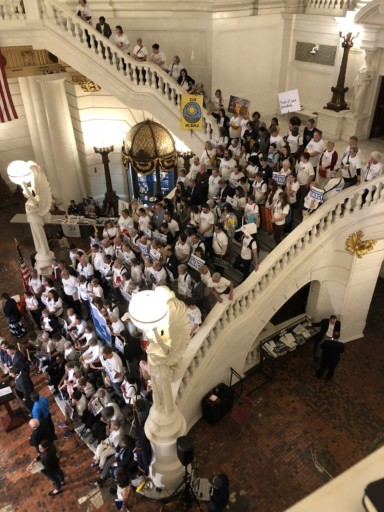
Where’s Waldo? (Hint: halfway up steps on right)
And, here he is:
 Notice, too, all the plastic signage (including a puzzling and perhaps recycled “China Win” poster held by one apparently serial protester), the plastic clothing and the plastic eyeglass frames, all of this taking place in a Pennsylvania Capitol Complex directly and indirectly heated with oil and gas. There are none so airheaded as those who refuse to think or deal in facts.
Surpise (Well, Not Really): Tesla’s Solar Business Is in Trouble
Speaking of being blinded, here’s the latest update on Governor Corruptocrat’s bad dream come true:
Investors were caught off guard this week when Elon Musk announced Tesla (NASDAQ:TSLA) was cutting 9% of its workforce in a move dubbed as a “companywide restructuring.” What hasn’t received as much attention is that this looks like another move to slowly shut down Tesla’s solar business.
Tesla has been shutting down its solar business since acquiring SolarCity for $2.6 billion in late 2016, and this could accelerate the former industry leader’s demise. Installations, which peaked at 253 megawatts (MW) in the fourth quarter of 2015, fell to just 76 MW in the first quarter of 2018 and show no signs of recovering. Tesla may be using its layoff announcement to shrink the solar business further, which may have long-term consequences for the broader company…
As part of the announcement, Musk also said a deal with Home Depot would be discontinued only four months after it was launched. which will undoubtedly lead to reduced solar installations. Sales efforts will be moved to Tesla’s retail showrooms, leveraging existing staff there, but showrooms haven’t proven to be a good place to sell solar. Again, it looks like solar will be de-emphasized after this week’s announcement.
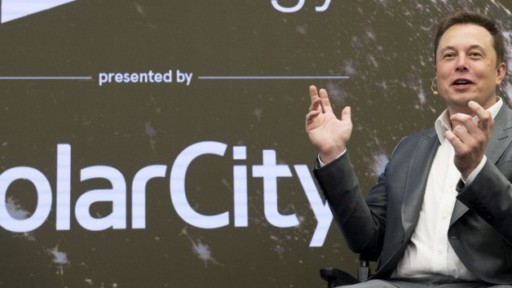
Well, he certainly can’t say we didn’t tell him, can he? He shouldn’t have needed us to tell him, though. His first clue should have been when the SolarCity asked for a “Get Out of Jail Free Card,” don’t think you think?

Who Will Become the First Master Builder of Clean Energy?
By Steve Heins, The Word Merchant
Many have probably heard a lot about Tesla lately, including the latest dust up with the “Autopilot” accidents. Beneath the headlines, the recently announced Tesla and Solar City merger will be an interesting experiment: Can massive government spending stimulate its own economy, without the usual worry about return on investment or real market demand. Stated differently, can the public sector make “better” and more clean energy choices than the private sector?u
First, with so many phrases being bandied about by the energy and environmental communities like “sustainable,” “clean,” “renewable,” and “environmentally friendly,” a broader meaning is required: “Clean energy” is energy efficiency, solar, wind, large scale battery storage, new gas/natural gas pipelines, new state of the art transmission lines, geothermal, hydro, improved and cleaner coal power plants, wave, new or updated nuclear power plants, and new natural gas power plants. They are all a part of a global greenhouse gas emission reduction strategy that at a minimum doesn’t damage the 3 billion people living in poverty, and 1.6 billion people still living without clean water, reliable electricity and inadequate telecommunications.
A necessary measuring stick is that all “clean energy” must share the ability to be measured and verified over time. Also, instead of the many imperfections of the cap and trade platforms like the European Union’s Emission Trading Scheme (and its ilk) and the carbon tax, the plan should be all inclusive. Renewables would not be treated as the only tradable emission credit, voluntary or otherwise. This notion reflects a sense that a 100 % renewables world isn’t a sacred goal nor is it even desirable.”
Frankly, when it comes to global economic development, the political class has proven, at their best, that they are enormously vulnerable to the Chinese menu of human frailties. Conversely, the private sector corrects its own historical mistakes, if only for economic survival.
Even the most recent example of a successful federal program, the Internet itself, only became commercialized and successful, after the heavy-handed regulation by the federal government was supplanted with technologies developed in the private sector. The TCP/IP protocol was established in 1983, and the invention of the browser by Marc Andreesen in 1993. Unlike the inevitable ossification of any large government entity, the private sector has the ‘machinery for change”, as Leonard Cohen put it.
One could argue, as the Wall Street Journal does, that Telsa and Solar City are both taxpayer subsidized companies. In fact, neither company has returned its first dollar of profit.
Essentially, the public sector, including well-funded politically active environmental groups, have decided that the solar industries, coal capture, electric cars, and large scale storage batteries are some of the best investments for the future of energy, economic development and environmentalism. “Tesla customers can drive clean cars and they can use our battery packs to help consume energy more efficiently,” as stated in a recent Tesla blog, “but they still need access to the most sustainable energy source that’s available: the sun.”
Lost in Tesla’s quote is the fact that the solar industry, coal capture or battery storage business cannot yet be defined as a “clean energy” sources, at least until they can prove they have the profitability and scalability to create the enormous amount of capital necessary for the global infrastructural investments, and all without the kindness of governmental assistance.
Currently, the public sector seems awash in money for renewables, studies and reports dedicated to the environmental community by the environmental and energy agencies. In addition, there is large amount of money that is being donated by individuals and foundations to environmental organization, which receive public or private funding.
At a minimum, there must be full disclosure of all public sector funding, when these funds and grants are received and expended on these environmental and economic debates. In a world flooded with funding biases and dubious economic claims, material facts help Wall Street and global investors keep the world in economic perspective no matter what is being said in public about energy and the environment.
After the failures of Solyndra, SunEdison, FutureGen in Illinois, the Kemper Project of Mississippi, Telsa and Elon Musk must grow from being great marketers to becoming a master builders of energy sustainability. If Telsa fails, they certainly will do irreparable harm to the credibility of federalism, renewables, and clean energy.
####